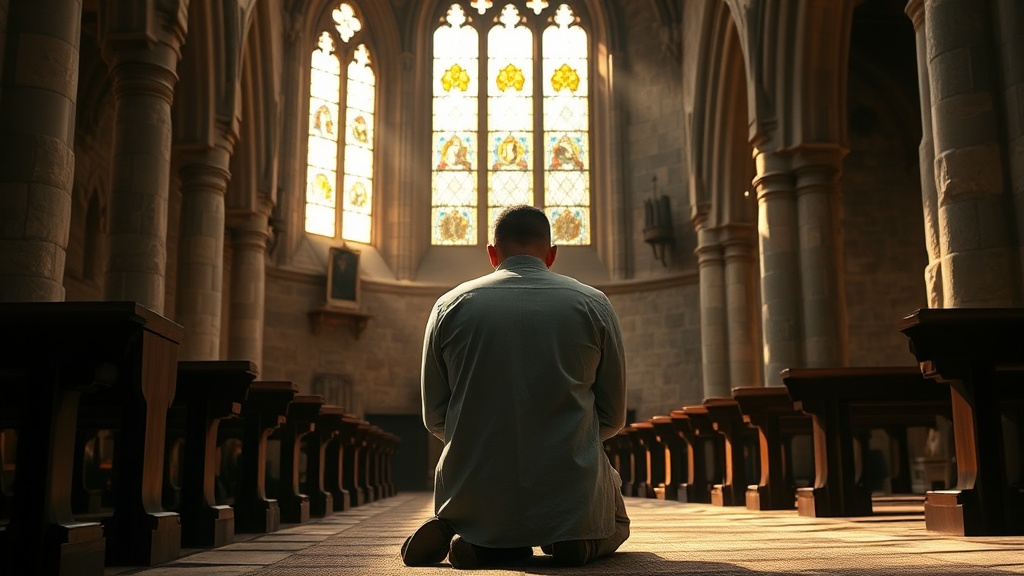
Grief After Suicide: A Christian Guide for Survivors Carrying the Uncarriable
Grief after suicide is unlike any other loss. Survivor guilt, anger at God, the question of heaven — this guide addresses it all with honesty and Scripture.
Testimonio
Change your heart radically through the love of Jesus Christ.
Grief After Suicide: A Christian Guide for Survivors Carrying the Uncarriable
If you are in crisis or having thoughts of suicide, please call or text 988 (Suicide and Crisis Lifeline) or call 911 immediately.
You didn't just lose someone. You lost them in the most bewildering, devastating way a person can be lost — and now you're living with questions that no pastor, no grief book, and no well-meaning friend has fully answered. Why didn't I see it? Could I have stopped it? Are they okay? Is God angry at me for not doing more? Why does His silence feel so complete?
Grief after suicide is its own category of loss. It doesn't follow a predictable arc. It comes layered with things that other grief doesn't carry: the stigma that makes people go quiet around you, the survivor guilt that feels almost physical, the theological questions that Christian communities often handle poorly, and the specific replaying of conversations that never seems to stop.
This guide is not going to give you easy answers. There aren't any. But it will try to walk honestly into the places most Christian resources don't go — because you deserve honesty more than comfort right now.
How Suicide Grief Is Different From Other Loss
Grief researchers have documented that suicide bereavement carries a distinctly more complicated profile than other types of loss. That's not to rank suffering — all grief is real — but to name something true about your experience, so you don't feel crazy for finding this harder than other losses.
The traumatic element. Many survivors of suicide loss experience symptoms of PTSD alongside grief. The circumstances of the death are often traumatic — what you found, what you were told, what you're unable to stop seeing in your mind. This is trauma, not weakness. It deserves therapeutic support designed for traumatic loss, not just general grief counseling.
The search for cause and prevention. With most deaths, we ask "why?" in a philosophical sense. With suicide, the question becomes an investigation. We go back through every conversation, every warning sign, every moment where something might have been different. This forensic quality of suicide grief is one of its most consuming features. The brain keeps running the same simulations because it can't accept an outcome it should have been able to prevent — even when it couldn't.
The social dimension. People don't always know how to respond to suicide loss. Some avoid the topic entirely, which produces a painful silence around someone you love. Some say harmful things — "they're in a better place" (how do they know?), "God must have needed another angel" (this isn't biblical and it doesn't help), or worst of all, nothing at all. The social isolation that can accompany suicide bereavement adds another layer of grief to the primary loss.
The theological complications. Questions about salvation, judgment, and the character of God hit differently when the death was by suicide. We'll address these directly.
Survivor Guilt: The Loudest Lie in the Room
For most survivors, guilt arrives before many other emotions. It speaks in "if only" — if only I had called that weekend, if only I had noticed the signs, if only I had said something different in the last conversation, if only I hadn't been angry the last time we spoke.
This voice is relentless. And it is also a liar.
Here is what's true: suicide is the result of a person's psychological pain exceeding their capacity to bear it. Mental illness — depression, bipolar disorder, psychosis — distorts perception so completely that the sufferer often cannot perceive the love around them, cannot believe their death will matter to others, cannot think their way to a different solution. This isn't a romantic or exonerating claim; it's a medical description of what happens to a mind in that level of distress.
That means the dynamic you had with this person — even a difficult dynamic, even an imperfect relationship — was not the cause. Love, no matter how full, cannot always reach a mind that illness has closed. Presence, no matter how consistent, cannot always interrupt what mental illness has been building. The guilt you carry is evidence of how deeply you loved. It is not evidence that your love failed.
Lamentations 3:20 says: "My soul continually thinks of it and is bowed down within me." There's no instruction here to stop replaying it or to move on. There's only the honesty of a soul that cannot stop. Let that be true for you. You don't have to perform recovery.
The Specific Guilt of Christian Survivors
For Christians, survivor guilt often takes on theological clothing. I should have prayed more. My faith should have made the difference. God could have prevented this if I had been more faithful. This formulation makes the guilt even harder to examine because it sounds like humility or piety when it's actually a distorted understanding of how God works.
God's sovereignty does not mean your prayers were the variable that determined the outcome. The prosperity gospel version of faith — where sufficient belief produces desired results — is not the gospel of the cross. Jesus prayed in Gethsemane and the cup was not removed. Prayer is not a mechanism that produces guaranteed results; it is relationship with a God who acts within the world as He chooses. Your love for this person was not insufficient. Your faith was not the reason.
Anger at God: What to Do With It
Many survivors are angry at God. Some are furious — particularly those who prayed consistently for their loved one's healing, who believed God was going to intervene, who felt like the faith they exercised was not reciprocated.
If that's you, know this clearly: God is not fragile. He can hold your anger. He has held it before. The Psalms are full of it — "My God, my God, why have you forsaken me?" (Psalm 22:1). "How long, Lord? Will you forget me forever? How long will you hide your face from me?" (Psalm 13:1). "Why do you stand far off? Why do you hide yourself in times of trouble?" (Psalm 10:1). These are not the words of people who had resolved their relationship with God. They are people in the middle of genuine anguish, still talking to God, which is the definition of faith in the dark.
The theologian Walter Brueggemann argued that lament — honest, even accusatory prayer — is an act of trust. You only cry "why did you do this?" to someone you still believe exists and can respond. Polite, sanitized prayer is often a sign of emotional distance from God; raw, angry prayer is often a sign of desperate engagement.
So: be angry. Tell God. Use the psalms' language if yours isn't available. Psalm 22, Psalm 88, Lamentations — these are your text messages to God when your own words fail.
When God Feels Absent
Some survivors describe a complete spiritual flatness after suicide loss — prayer that feels like talking to a wall, Scripture that feels inert, worship that feels performative. This is not apostasy. It is a grief so deep it has temporarily silenced the experiential channels through which God often speaks.
John of the Cross called this the dark night of the soul — a season of spiritual desolation that God allows in the spiritual life, not to destroy faith but to deepen it. In the dark night, you don't feel God, and that absence is real. But the absence is not abandonment. Romans 8:38-39 is not a description of how Paul felt; it's a theological declaration about what is objectively true regardless of feeling: nothing — including the felt absence of God in grief — can separate you from His love.
The Question Everyone Is Actually Asking: Are They in Heaven?
This is the question beneath almost every other question in suicide loss. And most Christian resources either avoid it, answer it too quickly, or answer it in ways that cause more pain.
Here is an honest answer:
We don't know. And anyone who tells you with certainty — in either direction — is claiming knowledge they don't have. The final state of any person's soul belongs to God alone.
What we do know:
- Salvation is by faith in Jesus Christ, not by the circumstances of one's death (Ephesians 2:8-9).
- The "unpardonable sin" mentioned in Matthew 12 refers to persistent, ongoing rejection of the Holy Spirit — not a single act in a moment of severe psychological crisis.
- The famous statement that "nothing shall separate us from the love of God" (Romans 8:38-39) is not qualified by cause of death.
- Martin Luther wrote: "I don't have the opinion that suicides are certainly to be damned. My reason is that they do not wish to kill themselves but are overcome by the power of the devil."
- Chuck Swindoll's theological conclusion: "Suicide cannot snatch anyone from the Father's hand."
The most honest thing that can be said is this: God is the judge of all things. He sees the suffering your loved one was carrying. He sees the distorted thinking that mental illness produced. He sees what neither you nor they could fully see. And His mercy is wider than our categories.
That's not a guarantee. It's not meant to close the question. But it's worth holding alongside the grief, because the alternative — assuming condemnation — has no stronger scriptural support and causes immeasurable additional pain.
What Community Can and Cannot Do
Community matters enormously in suicide bereavement. Isolation is genuinely dangerous for survivors — the risk of complicated grief, depression, and in some cases suicidal thinking in survivors themselves is real.
What community can do:
- Show up consistently and keep showing up, because this grief doesn't resolve in weeks
- Say their name. Don't make the person who died the unspoken subject
- Ask "what was ___ like?" and genuinely listen
- Sit in silence without filling it with explanations or silver linings
- Help with practical logistics — food, childcare, estate matters — especially in the first weeks
- Follow up at six months, at one year, on their birthday — because the waves of grief return at these points
What community cannot do:
- Answer the unanswerable questions
- Remove the guilt or the replaying conversations
- Speed up the grief timeline
- Replace the specific loss
What community should not say:
- "They're in a better place" (you don't know that, and it dismisses the grief)
- "God must have needed them" (this makes God responsible for suicide)
- "At least they're not suffering anymore" (true but not comforting)
- "I can't imagine what you're going through" (this distances rather than connects — try "I'm here" instead)
- "Everything happens for a reason" (not helpful)
Specific Resources for Survivors
- American Foundation for Suicide Prevention (AFSP) Survivor Support Groups: afsp.org — runs in-person survivor support groups in many cities
- Alliance of Hope for Suicide Loss Survivors: allianceofhope.org — online forum and resources specifically for loss survivors
- Christian Association for Survivors of Suicide Loss: suicideloss.org — faith-based support and community
- Therapists specializing in traumatic grief — search Psychology Today using the "grief" and "trauma" filter; look for "traumatic loss" or "complicated grief" in their specialties
The Long Arc of Suicide Bereavement
Grief after suicide does not have a clear end point. It tends to ebb and flow rather than progress linearly. The first year is typically the most acute — the "firsts" without the person (first birthday, first holiday, first anniversary) are often intensely painful. The second year can sometimes be harder than the first, as the shock has worn off and the permanence becomes more real.
Longer term, most survivors describe a process of integration rather than resolution. The loss becomes part of who they are, a thread woven into their life rather than something they "get over." The goal is not to stop grieving but to be able to carry the grief without being incapacitated by it.
Markers of healthy grief movement:
- Being able to think of the person without being immediately overwhelmed
- Finding moments of genuine joy without guilt
- Being able to talk about them with some warmth alongside the sorrow
- Reconnecting with relationships and activities that matter
When to seek additional help:
- Persistent inability to function in daily life after the first few months
- Ongoing inability to eat, sleep, or care for yourself
- Your own thoughts of suicide or self-harm (please call 988 immediately)
- Complete social withdrawal that doesn't ease over time
- Severe depression that isn't shifting — this may be complicated grief requiring specialist care
Practical Steps for the Early Days
In the immediate aftermath:
- Don't make major life decisions (don't move, quit your job, end relationships) in the first several months if you can avoid it
- Eat, even if you don't want to. Your body needs fuel to grieve.
- Accept help with practical tasks — this is not weakness
- Create a small inner circle of 2-3 people you can be completely honest with
In the months that follow:
- Find a therapist experienced with traumatic loss, ideally one who is comfortable with your faith
- Consider a suicide loss support group — meeting others who understand specifically is different from general grief support
- Create some kind of memorial practice — a way of marking their birthday, their favorite place, something that honors them without requiring you to pretend they're not gone
- Journal the replaying conversations. Writing them out can help externalize what the mind keeps running internally.
A Prayer for Survivors of Suicide Loss
Lord, I don't know how to pray. I am angry and broken and the questions won't stop. I am holding a grief that has no map, and everyone around me either doesn't know what to say or says the wrong thing.
I need You to be present where I can't feel You. I need You to hold the person I lost in a way I couldn't, and I need You to hold me in a way I can't hold myself.
Give me grace for the guilt — the relentless "if only" that won't stop. Help me believe that love was present even when I couldn't see the danger. Help me to be angry at You without believing You've abandoned me — because the psalmists were angry at You too, and You kept their words in the Bible.
When I cannot pray, let the Spirit intercede with groans I don't have words for. Romans 8 says that's allowed. I need that to be allowed right now.
I am not okay. I am bowed down. And somehow I am still here. Let that be enough for today. Amen.
Testimonio is a Christian meditation app for the hard and honest moments of faith. Our "When God Feels Silent" series was built for exactly this kind of grief. Download the app for guided prayers, lament meditations, and Scripture for the dark places.
Frequently Asked Questions
Is suicide an unforgivable sin? No. The "unpardonable sin" in Matthew 12 refers to persistent, ongoing, willful rejection of the Holy Spirit — not a single act during a psychological crisis. Christian theologians from Luther to contemporary evangelical scholars have concluded that salvation is by faith in Christ, not determined by the circumstances of death. Someone who died trusting Christ does not lose that standing because of how they died.
How long does grief after suicide last? There's no universal timeline. Research suggests suicide bereavement tends to be more prolonged and complicated than other losses. Most survivors describe years rather than months. The goal shifts from "getting over it" to "integrating it" — learning to carry the loss as part of your life rather than expecting it to resolve and disappear. If grief is still severely impacting daily function after six months, please seek professional support.
How do I help a friend who just lost someone to suicide? Show up and keep showing up. Say the person's name. Don't avoid the topic. Don't offer explanations or theological silver linings. Ask "what was __ like?" and listen without offering solutions. Help with practical tasks (food, logistics, kids). Follow up at one month, three months, six months — the long-tail support matters more than the initial outpouring. The greatest gift you can give is sustained presence without an agenda.
What do I say to my children about a family suicide? This depends heavily on age. For young children, concrete, honest language is better than euphemism ("died by suicide" rather than "went to sleep" or "went away"). For older children and teens: honesty, space for questions, acknowledgment that this is confusing and painful, and openness to talking about the person who died. Children who are not given honest information often fill the gap with more frightening information of their own imagining. A child psychologist specializing in grief can help with family-specific guidance.
Continue your journey in the app
Guided meditations, daily Scripture, journaling with verse suggestions, and more — designed for your spiritual growth.