The Prodigal Son's Father: What Luke 15 Reveals About God's Love
Explore the prodigal son parable through the father's eyes. Discover what Luke 15 teaches about God's extravagant, pursuing love for His children.
Testimonio
Change your heart radically through the love of Jesus Christ.
The Prodigal Son's Father: What Luke 15 Reveals About God's Love
We often call it "The Parable of the Prodigal Son." But perhaps we've been naming it wrong all along. The true hero of this story isn't the wayward son who squanders his inheritance in reckless living. The true hero is the father—the one who waits, watches, runs, and restores.
In this single parable, Jesus gives us the most vivid portrait of God's love found anywhere in Scripture. And the more deeply we examine the father's actions, the more we discover truths about our heavenly Father that shatter our assumptions about who God is and how He feels about us.
The Context: Why Jesus Told This Story
To understand the parable's power, we must understand its setting. Luke 15 opens with a complaint:
"Then all the tax collectors and the sinners drew near to Him to hear Him. And the Pharisees and scribes complained, saying, 'This Man receives sinners and eats with them.'" (Luke 15:1-2, NKJV)
The religious leaders were scandalized. Jesus wasn't just tolerating sinners—He was eating with them. In ancient Near Eastern culture, sharing a meal was an act of intimate fellowship and acceptance. The Pharisees' accusation carried an implicit question: What kind of God would welcome such people?
Jesus answers with three parables: the lost sheep (Luke 15:3-7), the lost coin (Luke 15:8-10), and the lost son (Luke 15:11-32). Notice the progression: one in a hundred, one in ten, one in one. Each parable narrows the focus until we arrive at the most personal picture of God's love imaginable—a father yearning for his child.
The Younger Son's Insult
"A certain man had two sons. And the younger of them said to his father, 'Father, give me the portion of goods that falls to me.' So he divided to them his livelihood." (Luke 15:11-12, NKJV)
Modern readers often miss the shocking nature of this request. In ancient Jewish culture, asking for your inheritance while your father was still alive was essentially saying, "I wish you were dead. I want what's mine now."
The son's request is the Hebrew equivalent of mé'et ha-néchalah ha-nofelet li (the portion of the inheritance falling to me). According to Deuteronomy 21:17, the younger of two sons would receive one-third of the estate (the elder getting a double portion). But this division was meant to happen after the father's death.
The father had every right to refuse. He could have disowned his son. Instead, Luke records simply: "So he divided to them his livelihood."
The Greek word for "livelihood" here is bios (βίος)—not just property, but life itself. The father gave his son a portion of his very life. This is our first glimpse of divine love: God grants us genuine freedom, even when He knows we'll misuse it.
The Son's Descent
"And not many days after, the younger son gathered all together, journeyed to a far country, and there wasted his possessions with prodigal living." (Luke 15:13, NKJV)
The word "prodigal" comes from the Greek asotos (ἀσώτως), meaning "wastefully" or "dissolutely"—literally "unsavingly." He couldn't save himself, his money, or his dignity.
The son's journey to "a far country" (chora makra, χώρα μακρά) represents more than geographical distance. In Jewish thought, leaving the Holy Land meant leaving God's presence and covenant protection. The son deliberately removed himself from everything good.
Jesus doesn't sanitize what happens next:
"But when he had spent all, there arose a severe famine in that land, and he began to be in want. Then he went and joined himself to a citizen of that country, and he sent him into his fields to feed swine. And he would gladly have filled his stomach with the pods that the swine ate, and no one gave him anything." (Luke 15:14-16, NKJV)
For a Jewish audience, this was rock bottom. Pigs were unclean animals (Leviticus 11:7). To feed swine was to participate in Gentile defilement. The prodigal has become everything his upbringing taught him to despise—yet even the pigs eat better than he does.
The phrase "no one gave him anything" is heartbreaking. The friends who helped him spend his money have vanished. Sin always promises community but delivers isolation.
The Turning Point
"But when he came to himself, he said, 'How many of my father's hired servants have bread enough and to spare, and I perish with hunger! I will arise and go to my father, and will say to him, "Father, I have sinned against heaven and before you, and I am no longer worthy to be called your son. Make me like one of your hired servants."'" (Luke 15:17-19, NKJV)
The phrase "he came to himself" (eis heauton elthon, εἰς ἑαυτὸν ἐλθών) suggests that the prodigal had been beside himself—living outside his true identity. Sin always alienates us from who we really are. Repentance is, in part, returning to our true selves as children of God.
Notice what prompts his return: the memory of his father's goodness. Even the servants in his father's house have "bread enough and to spare." This echoes Romans 2:4: "The goodness of God leads you to repentance."
The son prepares a speech. He'll ask to be made a hired servant (misthios, μίσθιος)—a day laborer, the lowest rank in the household hierarchy. He knows he's forfeited all rights as a son. He only hopes for a servant's wages.
The Father's Love Unveiled
Here is the heart of the parable—and the heart of God:
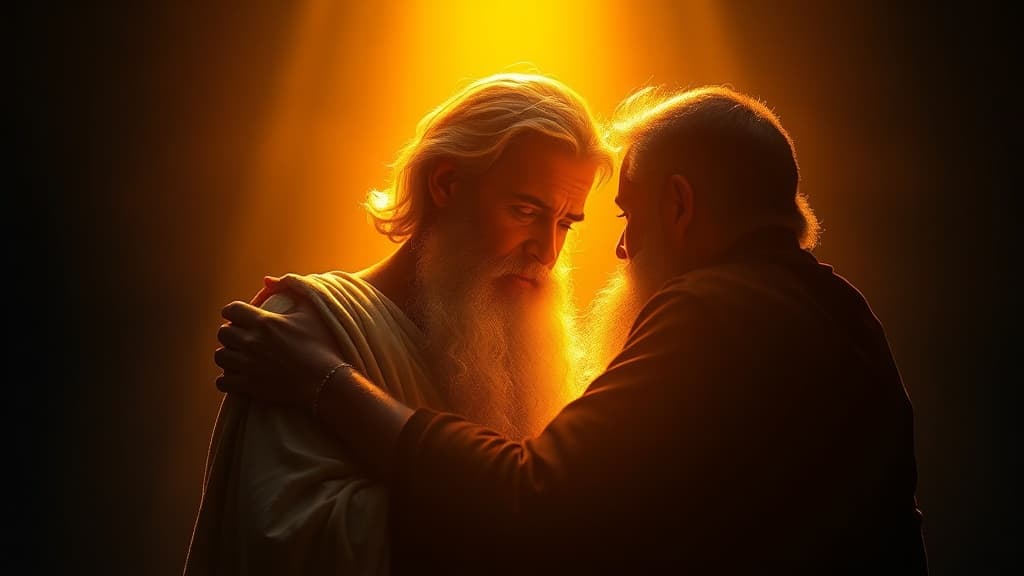
"And he arose and came to his father. But when he was still a great way off, his father saw him and had compassion, and ran and fell on his neck and kissed him." (Luke 15:20, NKJV)
Every phrase in this verse reveals something profound about God's love:
"When He Was Still a Great Way Off"
The father was watching. Day after day, he must have scanned the horizon, hoping for his son's return. The phrase suggests ongoing vigilance—a love that never stopped looking.
This is how God waits for us. He doesn't give up. He doesn't write us off. He watches and waits with eager anticipation for our return.
"His Father Saw Him"
In the Greek, eiden (εἶδεν) suggests more than mere sight. The father recognized his son despite the distance and the son's presumably haggard appearance. Love sees beyond the external.
"Had Compassion"
The Greek esplanchnisthē (ἐσπλαγχνίσθη) is one of the strongest words for emotion in the New Testament. It comes from splanchna, which refers to the intestines—the seat of deep emotion in ancient thinking. We might translate it "his gut wrenched" or "his heart broke."
This is visceral love. God doesn't observe our return with polite approval. He feels our return in His very being.
"Ran"
In first-century Middle Eastern culture, dignified men did not run. Running required hitching up one's robes, exposing the legs—behavior considered shameful for a patriarch.
But the father abandons propriety. He runs.
Kenneth Bailey, a New Testament scholar who spent 40 years in the Middle East, notes that this detail would have shocked Jesus' audience. The father is willing to shame himself to reach his son.
Does this not picture Christ Himself? The One who "made Himself of no reputation" (Philippians 2:7), who endured the shame of the cross, who ran toward us in our sin?
"Fell on His Neck and Kissed Him"
The Greek katephilēsen (κατεφίλησεν) is intensive—"kissed repeatedly" or "kissed affectionately." This isn't a formal greeting. It's an explosion of joy.
The son was filthy. He smelled like pigs. He was covered in the evidence of his sin. Yet the father embraces him anyway. Grace doesn't wait for us to clean ourselves up.
The Son's Interrupted Confession
"And the son said to him, 'Father, I have sinned against heaven and in your sight, and am no longer worthy to be called your son.'" (Luke 15:21, NKJV)
The son begins his rehearsed speech. But compare verse 21 to his planned confession in verse 19: the line "Make me like one of your hired servants" is missing.
Did the son forget? More likely, the father interrupted him. Before the son could demote himself to servant status, the father was already issuing commands:
"But the father said to his servants, 'Bring out the best robe and put it on him, and put a ring on his hand and sandals on his feet. And bring the fatted calf here and kill it, and let us eat and be merry; for this my son was dead and is alive again; he was lost and is found.' And they began to be merry." (Luke 15:22-24, NKJV)
The Best Robe
The Greek stole prōtē (στολὴ πρώτη) refers to the finest garment—probably the father's own robe, the one reserved for honored guests. The son who had stripped himself of dignity is now clothed in honor.
This pictures our righteousness in Christ: "I will greatly rejoice in the LORD, my soul shall be joyful in my God; for He has clothed me with the garments of salvation, He has covered me with the robe of righteousness" (Isaiah 61:10).
The Ring
The ring (daktylios, δακτύλιος) was a signet ring—a symbol of authority and family membership. It gave the bearer the right to act on the father's behalf. The son who had squandered his father's resources is now entrusted with the father's authority again.
This pictures our adoption: "Because you are sons, God has sent forth the Spirit of His Son into your hearts, crying out, 'Abba, Father!'" (Galatians 4:6).
The Sandals
Slaves went barefoot. Sons wore sandals. By putting shoes on his feet, the father is declaring: "You are not a servant. You are my son."
The Fatted Calf
A fatted calf (moschos ho siteutos, μόσχος ὁ σιτευτός) was reserved for the most significant celebrations. These animals were specially fed and could feed over 100 people. The father isn't throwing a small family dinner—he's hosting a village-wide feast.
This pictures the joy in heaven: "Likewise, I say to you, there is joy in the presence of the angels of God over one sinner who repents" (Luke 15:10).
What the Father's Love Teaches Us About God
1. God Respects Our Freedom
The father let his son go. He didn't force him to stay. He didn't manipulate or coerce. Love that isn't free isn't love at all. God grants us genuine agency—even the freedom to reject Him.
2. God Never Stops Watching
The father's vigilant waiting reveals God's persistent love. Psalm 139:7-10 reminds us there's nowhere we can flee from God's presence. Not because He's hunting us, but because He loves us.
3. God Feels Our Return
God isn't a distant deity observing from heaven. He is moved in His very being by our return. The father's compassion pictures a God whose heart breaks over lost children and rejoices over those who come home.
4. God Runs Toward Sinners
The father's undignified sprint shatters any image of a reluctant, angry God who must be appeased. God's posture toward repentant sinners is pursuit, not reluctance.
5. God Restores Beyond What We Deserve
The son asked to be a servant. The father made him an honored guest. God's grace always exceeds our requests and expectations. "Now to Him who is able to do exceedingly abundantly above all that we ask or think" (Ephesians 3:20).
6. God's Forgiveness Is Immediate and Complete
There's no probationary period. No lectures about the wasted money. No "I told you so." The moment the son returns, he's fully restored. "As far as the east is from the west, so far has He removed our transgressions from us" (Psalm 103:12).
The Elder Brother: A Warning
The parable doesn't end with the celebration. Jesus introduces a second son:
"Now his older son was in the field. And as he came and drew near to the house, he heard music and dancing... But he was angry and would not go in." (Luke 15:25, 28, NKJV)
The elder brother represents the Pharisees—those who never left home but whose hearts were far from the father. He reveals several dangers:
- Self-righteousness: "These many years I have been serving you; I never transgressed your commandment" (v. 29).
- Joyless obedience: He served, but he complained that the father never gave him even a goat for a party (v. 29).
- Contempt for sinners: He refers to his brother as "this son of yours" rather than "my brother" (v. 30).
- Misunderstanding grace: He couldn't celebrate restoration because he didn't understand love.
The father goes out to the elder son just as he went out to the younger. "Son, you are always with me, and all that I have is yours" (v. 31). The father loves both sons and pursues both.
The parable ends without resolution. We don't know if the elder brother joined the feast. Jesus leaves the question open because He's asking the Pharisees—and us—to answer it ourselves: Will you come in?
Practical Applications
1. If You're the Prodigal
Come home. The Father is watching. He's not waiting to punish you—He's waiting to embrace you. "Let the wicked forsake his way, and the unrighteous man his thoughts; let him return to the LORD, and He will have mercy on him; and to our God, for He will abundantly pardon" (Isaiah 55:7).
2. If You're the Elder Brother
Examine your heart. Is your obedience joyful or resentful? Do you celebrate when others come to Christ, or secretly resent God's generosity? Remember: everything the Father has is yours. You don't earn His love by performance.
3. If You're a Parent
Model the father's love. Give your children genuine freedom. Keep watching. Be ready to run. Don't withhold restoration waiting for them to prove themselves. Let them know they can always come home.
4. In Your Evangelism
Represent God accurately. The world thinks God is angry and distant. Show them a Father who runs.
Conclusion: The Father's Heart
Henri Nouwen, in his classic The Return of the Prodigal Son, wrote after meditating on Rembrandt's famous painting: "I am the prodigal son every time I search for unconditional love where it cannot be found."
But more than that, Nouwen realized he was called to become like the father—to develop "a heart that knows no bounds, that refuses to condemn, that is able to be patient."
The parable of the prodigal son is ultimately about the prodigal father—prodigal not in waste but in extravagant, reckless, pursuing love. This is who God is. This is how He feels about you.
Whatever far country you've wandered to, whatever you've wasted, however pig-stained your life has become—the Father is watching. And when you turn toward home, He will run.
"For this my son was dead and is alive again; he was lost and is found." (Luke 15:24)
You are that son. You are that daughter. And the feast is ready.
Come home.
Continue your journey in the app
Guided meditations, daily Scripture, journaling with verse suggestions, and more — designed for your spiritual growth.